What Is AEO? How B2B Companies Can Optimize for AI Answer Engines
AEO (Answer Engine Optimization) is the practice of structuring your content so that AI systems like ChatGPT, Perplexity, and Gemini cite you in their answers. Here's how it works for B2B.
AEO (Answer Engine Optimization) is the practice of structuring your content so that AI systems like ChatGPT, Perplexity, and Gemini cite you in their answers. Here's how it works for B2B.
The Direct Answer: What Is Answer Engine Optimization (AEO)?
Answer Engine Optimization (AEO) is the practice of structuring website content and entity data so AI systems—including ChatGPT, Perplexity, Google Gemini, Claude, and Microsoft Copilot—can accurately retrieve, understand, and cite your brand as an authoritative source in synthesized answers. Unlike traditional SEO which focuses on ranking in ten blue search result links, AEO optimizes for inclusion in direct conversational AI syntheses that increasingly serve as the starting point for B2B software and vendor evaluations.
For B2B founders and marketing leaders, winning AI citations requires clean HTML structure, question-led headings, direct BLUF (Bottom Line Up Front) answers, and verified entity signals.
Why B2B Companies Should Care Now
Three macro shifts make AEO urgent for B2B organizations in 2026:
Buyer research is shifting. Industry estimates indicate that over 30% of B2B software research queries now start in an AI chat interface rather than a traditional search engine.
AI answers are "winner-take-most." Unlike a search engine page with ten organic links, an AI response typically synthesizes and cites only 2 to 4 primary sources. If your content is not retrieved, your brand is effectively invisible during initial buyer evaluations.
First-mover authority compounding. AI models rely heavily on knowledge graph entity associations and authoritative co-occurrences. Establishing citation dominance early creates lasting semantic authority.
How AI Answer Engines Select Sources
Visual Step-by-Step Flow
How AI Answer Engines Choose What to Cite
The 4-stage pipeline from web crawling to synthesized cited answer
1Discovery
🕷️Crawl
AI bots (GPTBot, PerplexityBot) scan your web pages and structure.
2Parsing
🧩Chunk
Content is split into modular sections based on your headings.
3Matching
⚡Retrieve
When a user asks a question, the AI retrieves the most relevant chunks.
4Synthesis
🔗Cite
The AI answers the user and cites your website as the authoritative source.
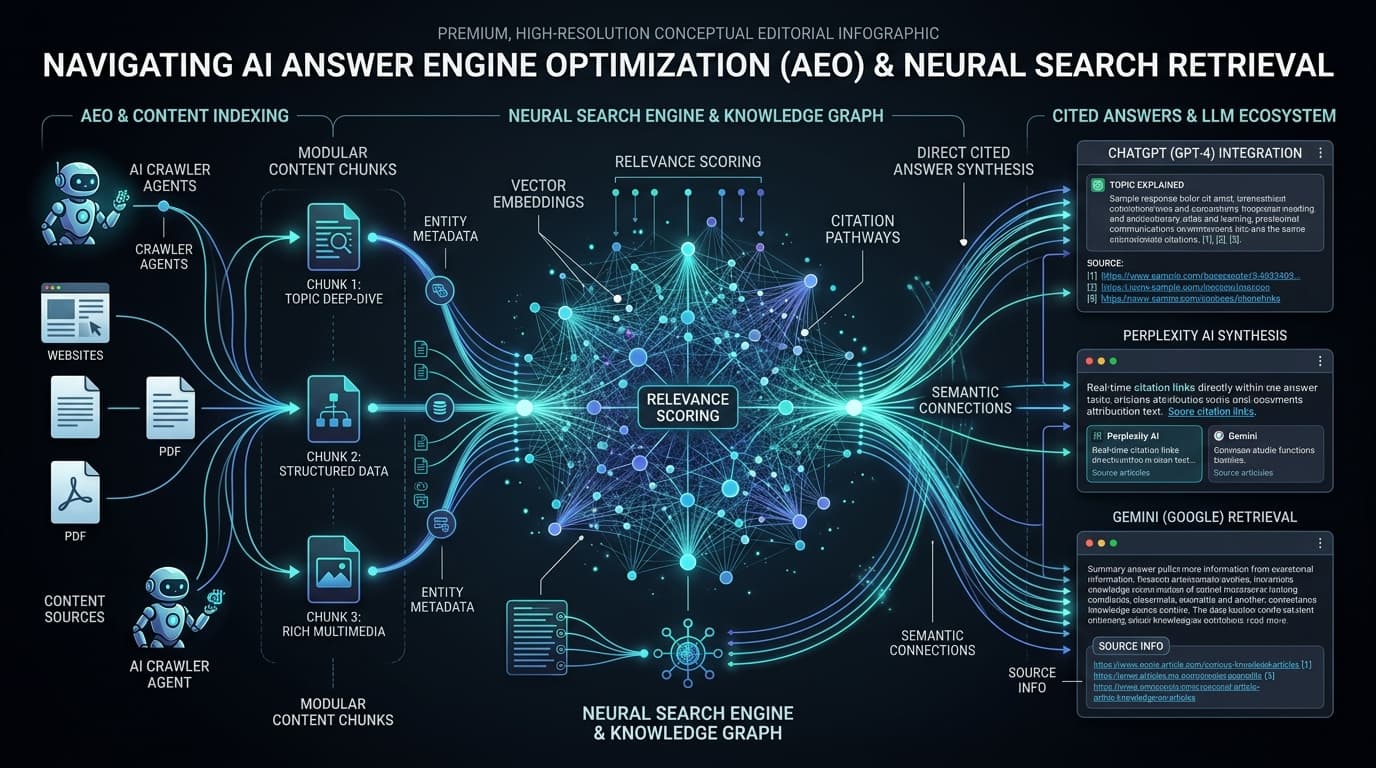
Understanding the retrieval-augmented synthesis pipeline helps you structure content for maximum extractability:
Crawl & Discovery: AI crawlers (e.g., GPTBot, PerplexityBot, ClaudeBot) index server-rendered content and inspect sitemaps and llms.txt files.
Chunking & Vector Embedding: Content is split into self-contained topical sections (typically bounded by <h2> and <h3> tags) and embedded as vector representations.
Retrieval: When a buyer submits a prompt, the system performs semantic search across vector databases to identify the most relevant passages.
Synthesis & Attribution: The LLM synthesizes the retrieved chunks into a coherent answer, appending citation links to the source domains.
To rank in this pipeline, content must be:
Crawlable: Server-rendered HTML rather than client-only JavaScript SPAs.
Well-Structured: Descriptive headings formatted as clear questions or explicit topic labels.
Chunk-Friendly: Each section provides a self-contained direct answer before expanding into nuances.
Authoritative: Backed by verified E-E-A-T signals (Experience, Expertise, Authoritativeness, and Trustworthiness).
AEO Ranking Factors: How AI Search Engines Choose Sources (2026)
Composite analysis across Perplexity, ChatGPT Search, Gemini, and Google AI Overviews
Factor
Weight Signal
Why It Matters
Simple Action Plan
Direct Q&A Answer Format
Very High
AI engines scan for explicit Q&A patterns to generate direct answers
Open each section with a direct question and 2-sentence direct answer
Structured Schema Markup
Very High
Helps AI crawlers understand page facts without guessing
Add FAQ and Article schema to your website pages
Primary Source Citations
High
Citing trusted research builds authority and trust
Link to recognized research reports and industry documentation
Content Freshness & Dates
High
AI engines prefer up-to-date content for time-sensitive topics
Show clear last-updated dates on your guides
Clean Headings (H1/H2/H3)
High
Organized headings help AI parse document sections
Use 1 main title, descriptive subheadings for each topic
Clear, Simple Language
Medium
AI engines favor content readable by everyday business readers
Use short sentences, explain acronyms, avoid filler jargon
Internal Topic Links
Medium
Topic authority is built by linking related guides together
Link to your related guides and case studies across your site
Factors are ranked by frequency of citation in AI engine answers, not by proprietary algorithmic weight.
AI answer engines do not evaluate keyword frequency in isolation; they map semantic relationships across the web:
Legitimate author bylines with domain context: Content published under transparent editorial bylines with clear organizational context signals higher trustworthiness.
External primary citations: Referencing verifiable industry research (e.g., official vendor documentation, academic research, public technical standards) indicates grounded claims.
Keyword stuffing in meta tags: Modern LLMs evaluate semantic meaning across full paragraphs; keyword repetition degrades model confidence.
Gating foundational educational content: AI crawlers cannot fill out lead forms. Keep core tactical frameworks open-access.
Publishing thin AI-generated articles at scale: High-volume superficial content lacking original benchmarks or expert insight fails retrieval quality filters.
Neglecting internal link architecture: Contextual links between related guides help AI crawlers understand your site's knowledge hierarchy.
Traditional Google SEO vs. Modern AI Search (AEO)
✕Traditional Google SEO
✓Modern AI Answer Engine (AEO)
Measuring AEO Success
Tracking AEO requires monitoring citation frequency alongside traditional analytics:
Metric
Measurement Method
Strategic Value
AI Referral Traffic
GA4 referral filters for chat platforms (ChatGPT, Perplexity)
Direct inbound pipeline
Citation Share of Voice
Regular prompt audits for category target queries
Brand authority & category positioning
Search Console AI Syntheses
Google Search Console appearance filters for AI Overviews
Visibility in search syntheses
Entity Co-Occurrence
Checking prompt outputs for brand mentions alongside category peers
Knowledge graph inclusion
The primary test for any B2B brand: when a prospect asks an AI engine for recommendations in your category, does the system cite your publication or framework as a trusted source?
Summary & Related Reading
Optimizing for AI answer engines is not about finding shortcuts—it is about publishing clear, authoritative, and cleanly structured information that AI systems can confidently recommend to enterprise buyers.
Uncoordinated AI integrations frequently create conflicting CRM writes and pipeline reconciliation friction. Learn how enterprise RevOps leaders leverage hybrid reasoning architectures, deterministic schema validation, and dual-loop HITL controls to eliminate data collisions and stabilize forecasting.
Microsoft has officially consolidated its enterprise AI roadmap into the unified 'AI at Work' agentic architecture. Explore how autonomous Sales Development Agents operate natively inside Outlook, Teams, and Dynamics 365.