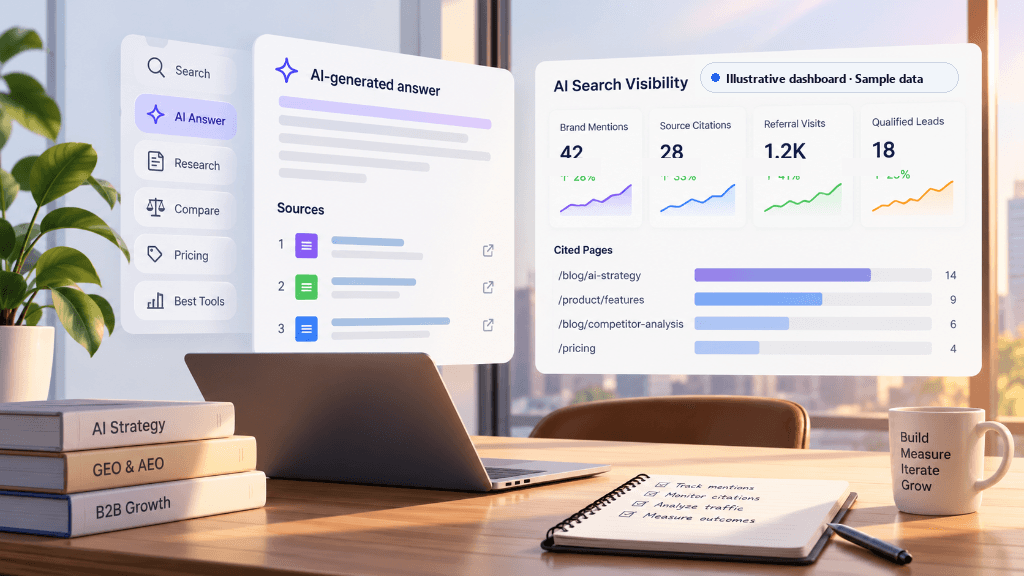
AI answers are becoming another place where customers discover companies. But mentions, citations, website visits and revenue are different signals—and measuring them requires more than a single GEO score.
B2B teams should measure AI search visibility in four separate layers:
- Presence: Does the company's name appear in answers to relevant customer questions?
- Citations: Are the company's webpages linked as sources in those answers?
- Visits: Are people arriving at the website from AI platforms or other discovery surfaces?
- Business outcomes: Do those visits and discovery interactions contribute to qualified leads, opportunities or revenue?
These layers are related, but none should be used as a substitute for the others. A company can be mentioned without receiving a citation. A cited webpage can receive few visits. Referral traffic can grow without generating qualified opportunities.
The useful goal is not to manufacture an impressive AI-visibility score. It is to understand where customers discover the business, how accurately its products are represented, and whether that discovery helps people take meaningful next steps.
As detailed in our foundational guide on what is AEO and answer engine optimization, optimizing for generative discovery means communicating clearly and providing reliable evidence—not relying on superficial ranking tricks.
AI-generated answers are becoming a more prominent part of commercial discovery, but the scale depends on the search platform, query, market and measurement method.
In an October 2026 study, Semrush tracked 400 US desktop commercial keywords across banking, software and ecommerce. Google AI Overviews appeared on 88% of that sample in August 2026, up from 45.75% in September 2025. The tracked queries included comparisons, alternatives, reviews and pricing-related searches. Read Semrush's study.
That is a meaningful change within the measured sample. It is not proof that 88% of all Google searches contain an AI Overview, and it does not show how many clicks or sales businesses gained or lost. Its value is in demonstrating why commercial search visibility should be measured rather than assumed.
There is also a stability problem. Search Engine Land reported an Envoyra study that analyzed 2,720 answers across four AI assistants over four weeks. The study found at least one change in recommended brands for 79% of tested question-and-assistant combinations. Read the study coverage.
That result is specific to the study's prompts, platforms and observation period. Still, it raises an operational question for B2B companies: a brand that appears in one answer today may not appear in the same way when the same question is tested later.
The practical implication is straightforward. A single screenshot, one prompt or one successful result is not a reliable measurement programme.
A mention occurs when an AI-generated response names your company, product or brand. Record whether the mention is accurate, relevant and accompanied by a meaningful description.
A mention is not necessarily an endorsement, recommendation or source citation. A company can be named in a comparison without its own webpage being linked.
A citation occurs when an AI answer visibly links to a page on your website as supporting material.
Record the exact URL, the topic of the question, the platform and the context in which the page was used. A product page might support a question about features, while a technical guide might support a question about implementation.
Do not treat every citation as a click. Bing's AI Performance documentation distinguishes visible citation activity from traffic and authority. Read Bing's AI Performance documentation.
Referral traffic measures visits that analytics attributes to another website or service.
Google Analytics source and medium dimensions can help identify traffic origins, including referring websites. Read Google's traffic-source documentation.
However, a visitor's path through an AI assistant may not always be fully identifiable. A citation count cannot tell you how many people clicked, and analytics may not reliably reveal every prior interaction that influenced a visitor.
The most commercially useful signals are outcomes such as relevant demo requests, sign-ups, qualified leads and opportunities.
Use your existing analytics and CRM attribution practices to connect observable traffic with business outcomes where possible. Ask relevant leads how they discovered the company when that information is useful and collected appropriately.
Do not claim that an AI mention caused a sale unless your evidence supports that conclusion. In many cases, AI discovery is one part of a longer customer journey.
Start with a manageable set of customer questions rather than attempting to monitor every possible prompt.
For example, a B2B software company tracking competitor and market signals, as discussed in our guide to AI sales tools for competitive intelligence, might test questions in five groups:
| Question Type | Example Prompt |
|---|
| Problem discovery | How do revenue teams identify competitor activity? |
| Product discovery | What software helps sales teams find competitive intelligence? |
| Comparison | What are the differences between two sales intelligence platforms? |
| Buying evaluation | What should a business check before choosing a sales intelligence tool? |
| Implementation | How can a team integrate sales intelligence into its CRM workflow? |
These are illustrative questions, not measured industry benchmarks. Replace them with questions that reflect your audience, product category, sales conversations and existing keyword research.
For each test, record:
- The exact question or prompt.
- The platform and date of the observation.
- The region and other conditions that could affect the response, where known.
- Whether the brand appeared and how it was described.
- Whether the response linked to one of your webpages.
- The cited URL and the other sources shown.
- Whether the description was accurate and current.
- Any relevant follow-up visit or business outcome that can be reliably attributed.
Use the same core question set when comparing periods. Otherwise, changes in the questions themselves can be mistaken for changes in visibility.
AI responses can vary across sessions, accounts, regions and platform updates. Record the testing conditions and treat your observations as a sample, not a universal representation of every user's experience.
A useful internal dashboard does not need to compress everything into one score.
| Metric | What It Tells You | How to Interpret It |
|---|
| Brand mention rate | How frequently the brand appears in the tested answers | Useful for comparing the same prompt set over time |
| Citation rate | How frequently the website is cited in the tested answers | Track only where the platform exposes citations |
| Cited-page coverage | Which distinct URLs appear as sources | Reveals which pages support which types of questions |
| Accuracy rate | How often the brand or product is represented correctly in reviewed answers | Helps identify misleading descriptions or outdated information |
| AI-attributed referral visits | Visits analytics identifies as originating from AI services | Useful, but incomplete attribution is possible |
| Qualified conversions | Relevant actions from visitors or leads associated with those sources | Closer to business value, but causation may remain uncertain |
For internal testing, define every denominator explicitly.
For instance, a brand mention rate could be calculated as the number of eligible test responses mentioning the brand divided by the total eligible responses examined. A citation rate could use the number of eligible responses citing at least one page from the company, divided by the eligible responses in which citations can be observed.
These are proposed internal definitions, not standardized industry metrics. State your definitions in the dashboard so results remain comparable.
Avoid comparing raw counts from different assistants as though their response volumes or citation behavior were identical.
Use the existing Search Console reports to monitor search performance and review the official reporting available for Google's generative AI search features. Google continues to emphasize standard SEO foundations, technical eligibility and helpful, distinctive content in its official generative AI optimization guidance.
Search visibility does not necessarily lead to a click. Compare relevant search impressions, clicks and subsequent website behavior instead of interpreting visibility as traffic.
Bing's AI Performance reporting can show which pages are cited in supported AI-generated answers and the grouped queries associated with that citation activity.
Use it to discover which parts of your content are being referenced and how those signals change over time. Do not treat citations as a ranking score or proof of commercial impact. Read the tool documentation.
Use analytics to understand observable referral traffic, landing pages, engagement and conversions. Connect relevant outcomes to the CRM when your existing tracking permits it.
Keep attributed results separate from unobserved influence. If the data cannot show that a visitor came from a particular AI assistant, report the limitation instead of filling the gap with an assumption.
A controlled sample of manually tested questions can help teams understand how different platforms describe their products and which sources they cite.
Use this as a consistent research method, not a substitute for official analytics. Respect each service's terms and access restrictions; do not build the measurement programme around unauthorized scraping or automated account activity.
SEO refers to search engine optimization. AEO is commonly used for answer engine optimization, while GEO in this context means generative engine optimization.
These labels describe overlapping practices, not three guaranteed ranking systems with separate tricks. Our practical breakdown of B2B answer engine optimization principles explains how to create content that is easy for readers and search systems to understand.
Google's guidance is particularly important: existing SEO best practices remain relevant to AI search, and the company does not prescribe special schema markup or additional technical requirements just to appear in AI Overviews or AI Mode. Read Google's official guidance.
For B2B publishers, focus on the foundations:
- Keep important pages discoverable. Ensure public articles can be crawled and indexed where appropriate. Maintain correct canonical URLs, internal links, a valid sitemap and accurate robots directives.
- Write content that answers real questions. Explain concepts clearly, define technical terms, give relevant examples and address the questions buyers actually ask. Do not pad articles with repetitive summaries simply to create more headings.
- Provide evidence and original insight. Attribute research and statistics, link to primary sources where possible, explain limitations, and distinguish observations from recommendations.
- Make page structure understandable. Use meaningful headings, descriptive links, readable tables and relevant image alt text. Keep essential information available as accessible text.
- Maintain accurate structured data. Reuse the site's valid article metadata and existing Article or BlogPosting schema where applicable. Structured data must match the visible page. Do not add fabricated author credentials, false publication dates or unsupported claims.
- Avoid supposed GEO shortcuts. Do not stuff brand names into content, manufacture mentions, publish generic pages solely to target prompts, or assume an
llms.txt file or a special schema automatically creates AI visibility.
These practices can improve clarity, discoverability and trust. They cannot guarantee citation or recommendation by any AI platform.
- Week 1: Establish a baseline. Select a fixed set of customer questions and document the results on the AI platforms relevant to your audience. Record brand mentions, cited URLs and the testing conditions.
- Week 2: Check technical accessibility. Review indexing, canonical URLs, internal links and the accessibility of important product and educational pages. Use official webmaster tools rather than relying solely on manual searches.
- Week 3: Improve the pages that matter. Update outdated facts, unclear product descriptions, missing supporting evidence and weak explanations. Add meaningful internal links and ensure every major factual claim has an appropriate source.
- Week 4: Review the signals. Repeat the original tests and compare like with like. Look for changes in mentions, citations, cited-page coverage and observable referrals. Record uncertainty and avoid attributing every change to your edits.
The objective is to establish a reliable learning loop, not to promise that one month of optimization will produce a particular ranking or revenue increase.
No. Google's published guidance states that its AI search features continue to rely on the foundations of its Search systems. Technical eligibility, useful content and discoverability remain important.
No. A response can mention a brand without linking to its website. A citation records a visible source link when the platform supplies one. Track them separately.
Not necessarily. A citation is not a click. Pair citation observations with analytics and business outcomes while acknowledging attribution gaps.
Start with a consistent monthly baseline, then increase the frequency if the category is changing quickly or the results inform an important decision. A stable testing method is more useful than collecting large amounts of incomparable data.
No. GEO and AEO can be useful labels for thinking about discovery through generated answers, but they should not be treated as a reason to abandon standard SEO. Follow the relevant platform's published guidance and prioritize content that genuinely serves the reader.
AI search visibility is not a single metric. It is a collection of signals describing whether a brand is mentioned, whether its webpages are cited, whether people visit the site and whether those interactions contribute to business results.
For B2B founders, the best starting point is a repeatable set of customer questions, transparent measurement definitions and content that is accurate, useful and supported by evidence.
You do not need to chase every new GEO tactic. You need to know where your audience is finding information, which of your pages help answer its questions and whether that visibility makes a measurable difference to the business.
Editorial disclosure: This article combines published research and official platform documentation with original AI Founders Talk analysis. Vendor-study statistics are attributed to their publishers and limited to the samples described. The article does not claim to guarantee search rankings, AI citations, traffic or commercial results.