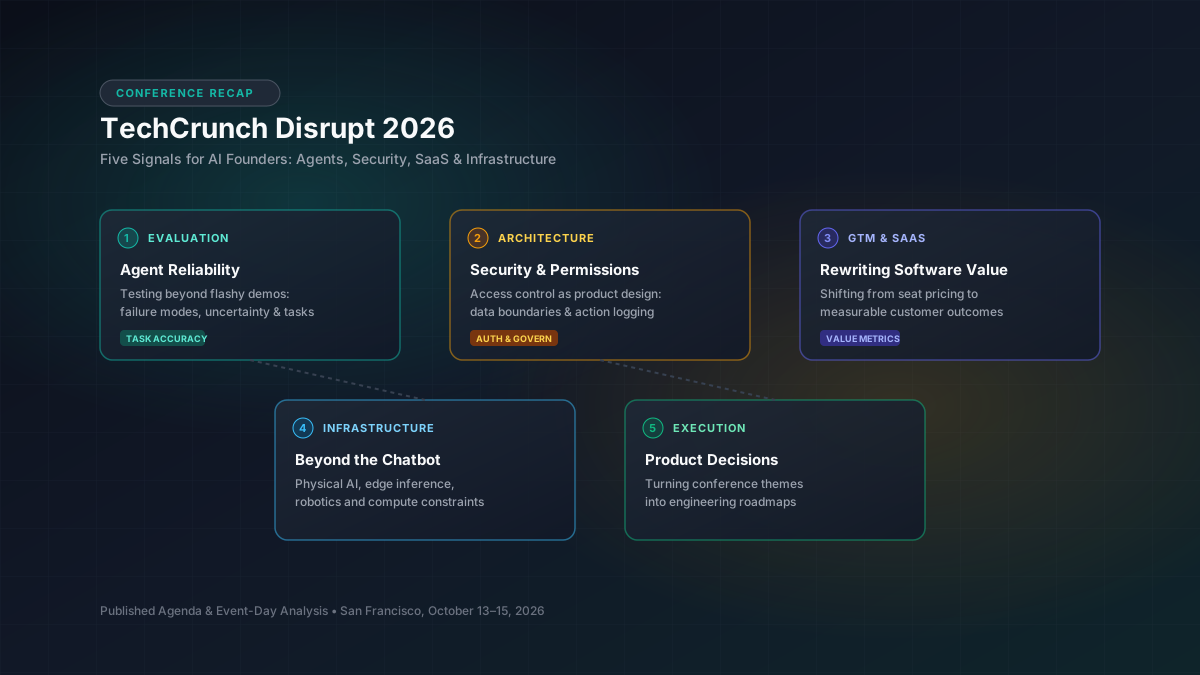
The three-day San Francisco event ran October 13–15. Its published agenda and event-day coverage highlight questions AI founders should consider as they build products and teams.
TechCrunch Disrupt 2026 brought together startup founders, investors and technology leaders in San Francisco from October 13 to 15. The published program included sessions on AI agents, model evaluation, software business models, AI infrastructure, robotics, hiring and startup growth. See the official event page.
This recap is based on the published event program and public event-day coverage, not a first-person account of attending the sessions or a transcript of every talk. The takeaways below distinguish announced session topics from AI Founders Talk's own interpretation.
The published agenda included a session titled Before You Let AI Do the Job, How Do You Know It Actually Can, featuring Irene Solaiman of Hugging Face. Its description focused on how AI capability and reliability vary by task, model and the consequences of failure, and on the emerging role of evaluation tools for testing systems before deployment. Review the official Disrupt agenda.
What founders can take away: A compelling demo is not sufficient evidence that an agent is ready for production. Test it against realistic tasks, uncertain inputs, exceptions and failure cases. Decide in advance what the system may do independently and which actions require human review.
For business software, a useful evaluation should examine whether the agent completes the intended task, follows permissions, produces verifiable outputs and handles uncertainty safely.
The published program included sessions on the agent-security problem and on who can access an agent's prompts. These topics highlight a practical question that arises when AI systems can interact with software, internal data and business workflows. See TechCrunch's October 14 event coverage.
What founders can take away: Treat identity, authorization, data access and action permissions as part of an agent's design. A system that can access a customer's records or change a business application requires more than a good prompt. It needs appropriate boundaries, logging, testing and a path for handling mistakes.
The useful product question is not only what the agent can do, but what it should be allowed to do.
The program featured a session titled Rewriting SaaS: Why AI Breaks the Old Business Model as well as a session on the GTM Engineer role. These subjects reflect questions about how AI changes software value, product delivery and the work involved in reaching customers. See the published final-day program.
What founders can take away: Adding AI functionality is not the same as creating a compelling business. Founders need to identify the user problem, demonstrate an improvement over the alternative and decide how the product's value should be priced and measured.
In sales and marketing, AI may change how research, qualification and operational tasks are performed. The business challenge is to show how those changes improve an outcome customers care about, rather than selling automation as an end in itself.
This is AI Founders Talk's analysis of the program topics, not a claim that every speaker reached the same conclusion.
The event program included discussions of robotics, operating AI where the cloud is unavailable, chip design and the limits of AI scaling. It also featured conversations about AI applied to the physical world. Explore the official conference program.
What founders can take away: AI products increasingly depend on more than the model itself. Infrastructure, hardware, latency, data access, safety requirements and the conditions in which a system operates can determine whether an application works outside a demonstration.
For startups considering physical AI or edge deployments, the operating environment is part of the product requirement. For software founders, compute and inference costs also belong in the business model.
A conference agenda can be useful because it reveals the questions founders and operators are examining. To turn those themes into action:
- For agent products: define task-specific evaluation criteria before expanding autonomy.
- For enterprise AI: make permissions, auditability and failure handling part of product design.
- For SaaS businesses: test whether AI improves the customer's outcome, not merely the feature list.
- For infrastructure-heavy products: evaluate cost, latency and operating constraints early.
- For go-to-market teams: connect automation to measurable customer acquisition, retention or productivity goals.
These are practical recommendations from AI Founders Talk based on the published agenda and event-day coverage. They should not be read as direct quotations or official conference conclusions.
TechCrunch Disrupt 2026's published program put several important startup questions in focus: whether AI agents can be evaluated reliably, how to secure the systems they use, how AI changes software business models, and what happens when AI moves into physical environments.
The practical lesson for founders is to connect AI capability to a clearly defined business problem. Reliable execution, customer value and the ability to operate safely matter more than a headline demonstration.
Editorial note: This is a public-source event recap based on the official program and published event-day coverage. It is not presented as firsthand attendance, a transcript or an endorsement by the event organizers or speakers.