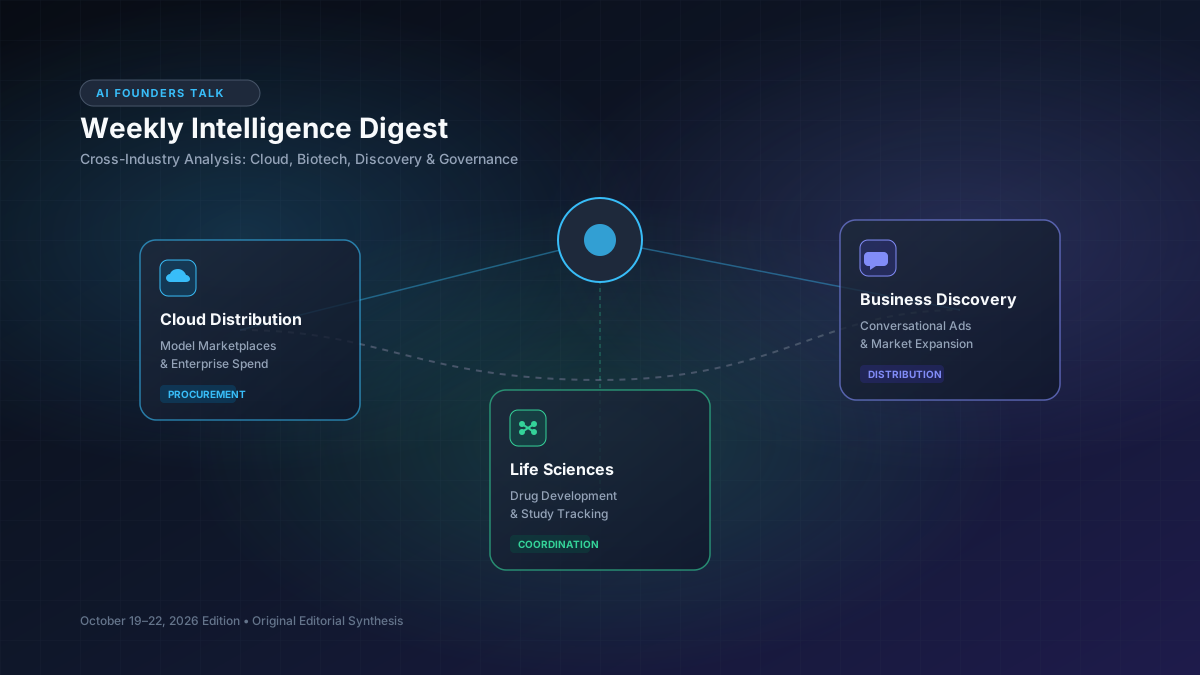
The developments worth watching this week—and what they could mean for founders, operators and business teams.
Several announcements between October 18 and 21 point to different parts of the AI market evolving at once: how enterprises buy models, how AI fits into specialist workflows, how businesses reach customers, and how AI companies structure public-benefit commitments.
These announcements do not all represent products that are generally available today. The distinction between a disclosed plan, an announced acquisition and a released capability matters when deciding what to test or buy.
On October 21, OpenAI announced a partnership to bring its frontier models and Codex agentic workflows into Google Cloud's Model Garden. OpenAI says customers will be able to purchase the models through Google Cloud Marketplace and, where applicable, use existing Google Cloud spending commitments. The announcement says general availability is planned for the coming weeks. Read OpenAI's announcement.
Reuters also reported the planned distribution arrangement and described the move as part of a wider trend in which cloud platforms are becoming important channels for distributing frontier AI models. Reuters' report.
Why it matters: Enterprise teams may have another procurement route for accessing advanced models inside an existing cloud environment. Governance, contracting and purchasing processes can be just as important as model capability when businesses move from experiments to production.
What to watch: Availability dates, regional access, model pricing, usage limits and applicable data-governance conditions. The announcement does not mean every customer can use every model immediately, and it does not eliminate the need to compare quality, latency and cost for a particular workload.
On October 20, OpenAI announced that it had acquired Orchestra Bio, a platform focused on coordinating work involved in drug development. OpenAI says it plans to bring Orchestra's technology and team together with Rosalind, its AI tools for life-sciences research. Read the company announcement.
The announcement describes workflows in which agents help monitor and track studies, identify dependencies between activities, and assemble information so scientists and program leaders can decide how to respond to problems.
Why it matters: This is an example of AI being applied to coordination across a complex professional workflow rather than only to answering isolated questions. Drug development involves scientific work as well as schedules, teams, studies and dependencies.
What to watch: How these tools are integrated into real scientific workflows, how human experts validate their outputs, and whether subsequent evidence demonstrates measurable improvements. The acquisition itself does not establish that new treatments will reach patients faster.
OpenAI announced on October 21 that ChatGPT Ads would expand into 26 additional countries, bringing availability to 89 countries according to the company's announcement. OpenAI also reported that more than 100,000 advertisers had run campaigns on the platform. These are company-reported figures. The announcement states that ads appear on Free and Go plans, while Plus, Pro and Enterprise subscriptions remain ad-free. Read OpenAI's advertising update.
Why it matters: Conversational AI is becoming another surface that businesses may consider for customer discovery and advertising. Unlike a conventional search-result page, a conversation can include follow-up questions and evolving requirements as someone evaluates a purchase.
What to watch: Advertiser eligibility, availability in target markets, campaign measurement, ad-labeling rules and the relationship between conversational discovery and existing marketing channels. Do not assume availability in a particular country without checking the official eligibility information.
On October 18, Anthropic announced a new Public Benefit Fund. The company said the fund would be allocated a portion of its shares, subject to stockholder approval, with a structure that could increase that allocation as the company grows. Anthropic describes potential uses that include support for public-benefit activities and responses to AI's wider social and economic effects. Read Anthropic's announcement.
Why it matters: The announcement raises a wider governance question for AI companies: how should the benefits created by commercial growth relate to broader public-benefit commitments?
The structure and its future impact should be assessed from the company's subsequent disclosures, formal approvals and reporting rather than assuming that an announced mechanism has already produced its intended outcomes.
Three practical themes emerge from these developments:
- Model access is becoming a procurement decision as well as a technical decision. Keep evaluating model quality, cost, permissions and reliability, while watching how purchasing channels evolve.
- AI is moving deeper into specialist workflows. In areas such as life sciences, useful automation may depend on connecting information, coordinating tasks and supporting expert decisions—not just generating text.
- New distribution channels need measurement, not hype. Whether evaluating conversational advertising or a new cloud marketplace, businesses should verify availability, define success metrics and test against their existing alternatives.
These announcements are signals to investigate, not proof that every business needs to change its architecture or marketing strategy immediately.
Editorial note: This roundup summarizes publicly announced developments and adds AI Founders Talk's own practical analysis. Company claims and intended outcomes are attributed rather than presented as independently verified results.