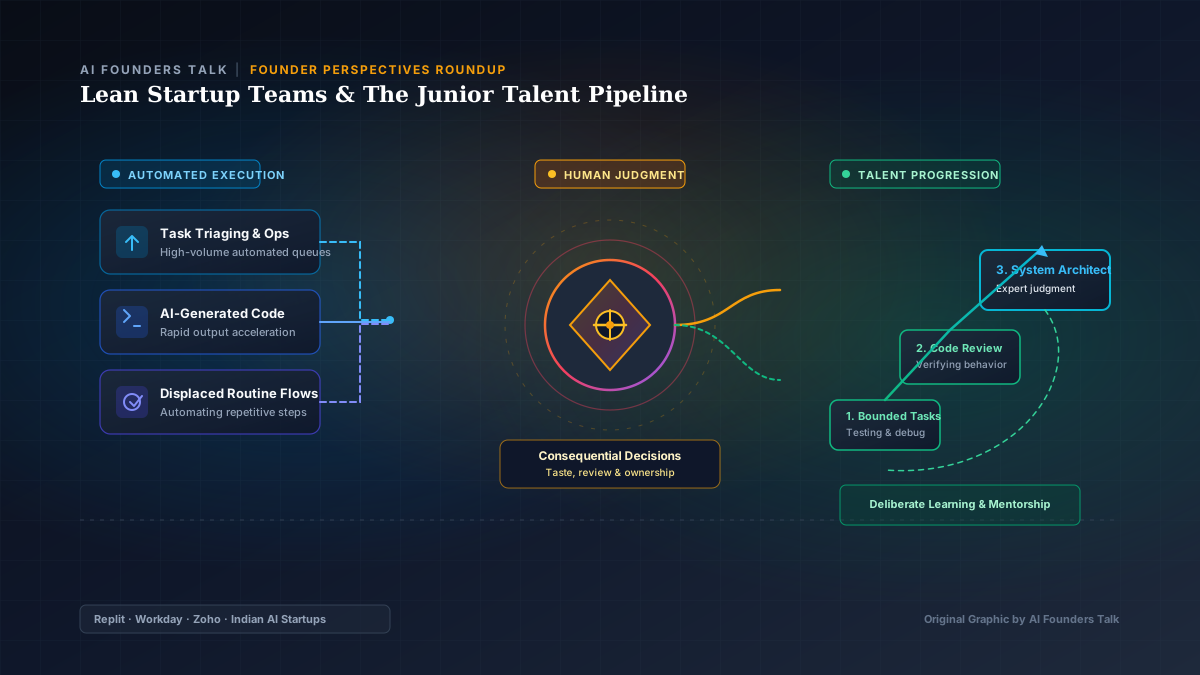
AI is changing how startup teams get work done, but founders and technology leaders are highlighting different consequences. Replit CEO and co-founder Amjad Masad has described agents taking on more operational work while people retain an important role in judgment. Workday co-founder Aneel Bhusri expects significant displacement in some routine jobs. Zoho founder Sridhar Vembu has raised a different concern: if AI reduces the opportunities available to junior engineers, where will tomorrow's senior technical experts gain their experience?
These perspectives point to a question founders cannot answer with productivity metrics alone: How can a company gain the benefits of AI today without weakening the development of human expertise tomorrow?
Replit's July 2026 account of its internal AI adoption reported substantial improvements in engineering output, alongside stable review times and no increase in reversions or product incidents. Those figures are Replit's own company-reported results, and they should not be treated as evidence that every organization can expect the same outcome. Replit's account of its operating model
At TechCrunch Disrupt in October, Masad discussed a workflow in which an AI agent initially examines and organizes incoming support tickets. A person still evaluates what should happen next, and an agent can then assist with preparing a software fix. The workflow illustrates a division of work: an agent handles parts of the execution, while a person remains involved at a consequential decision point. TechCrunch's report from Disrupt
The important distinction is between delegating execution and delegating responsibility. If agents can prepare more work for review, employees may spend less time on repetitive steps and more time deciding which problem deserves attention, evaluating trade-offs and checking whether a proposed solution is appropriate.
That is a plausible organizational opportunity, not a guarantee that automation will create enough higher-value work for everyone whose current tasks change.
Workday co-founder and CEO Aneel Bhusri has offered a less reassuring view of the transition. In an October 15 interview with Fortune, he predicted substantial job displacement within five years, particularly in repetitive business processes such as payroll work and parts of junior auditing. He also discussed the need to retrain workers affected by these changes. Fortune's interview with Bhusri
His view is a forecast, not a measured outcome. Yet it highlights a practical distinction that productivity conversations can overlook: a task becoming automatable does not necessarily mean that the person performing it will move smoothly into another role.
For a startup, the decision may involve more than whether a tool can perform a task at lower cost. Leaders must consider which responsibilities are changing, what happens to affected employees, and whether the organization has a credible path for training people to perform different work.
Retraining cannot be treated as a separate issue to address only after automation is complete. It belongs in the initial workforce plan.
Zoho founder Sridhar Vembu has raised a particularly important concern for engineering teams. In January 2026, he questioned what would happen if AI made senior architects more productive while reducing the demand for junior engineers. Senior experts do not appear fully formed; they gain experience through years of working on real systems, making mistakes, investigating failures and learning from more experienced colleagues. NDTV Profit's report on Vembu's concern
Vembu returned to a related concern in September, warning against allowing AI-assisted development to replace the team's understanding of the software it produces. His comments were reported by Moneycontrol. Moneycontrol's report on Vembu's September comments
These are connected issues. A team can use AI to accelerate coding while still needing engineers who understand requirements, verify behavior, diagnose failures and assess system-level consequences. If entry-level employees no longer receive enough hands-on work to develop these abilities, the short-term output improvement could come with a longer-term training cost.
This does not mean junior engineers must keep doing every task manually. It means companies need to design meaningful learning into AI-assisted workflows rather than assume it will happen automatically.
The discussion is not limited to US technology companies. In February 2026, ETtech reported that Prodigal founder Shantanu Gangal had reorganized engineering work into pods of three to four people responsible for large business lines, compared with teams that had previously been closer to 18 people. ETtech's report on lean AI-native teams
This is one company's reported organizational change, not a universal benchmark. It nevertheless illustrates why smaller, AI-enabled teams are attractive to founders: they can seek more output from each person without expanding headcount in the same way as a traditional organization.
The next question is how such teams develop their people. In a smaller group, each person's contribution and understanding can matter more. Founders need to consider not only which tasks are automated, but also how new employees learn the product, build sound judgment and progress towards greater responsibility.
Taken together, these accounts do not show that founders agree on a single future for work. They reveal three issues that should be considered separately.
- Productivity: Agents can take on parts of repeatable work and help people execute tasks more quickly. Replit's experience provides one company-reported example.
- Employment: Leaders such as Bhusri expect at least some tasks and jobs to be displaced. The scale and pace of that outcome remain uncertain; a forecast should not be presented as a settled result.
- Learning and expertise: Vembu's concern highlights the possible cost of reducing early-career opportunities without creating alternative ways to develop expertise. That is a management and workforce-design problem, not merely a software-tool problem.
AI Founders Talk's analysis is that a healthy AI-augmented organization needs to measure all three. Output alone cannot show whether the work is reliable, whether affected employees have a realistic path forward, or whether junior team members are developing the capabilities the business will need later.
Founders can begin with four actions:
- Design AI-assisted learning, not just AI-assisted output. Give junior employees meaningful responsibility for small, bounded tasks, debugging, testing, documentation and reviewing AI-generated work. Increase autonomy as their understanding develops.
- Measure quality alongside speed. Track rework, defects, review outcomes and whether employees can explain how a change works. More output is valuable only when the resulting work remains suitable for its purpose.
- Keep a human owner for consequential decisions. Define who reviews critical outputs, handles exceptions and accepts responsibility when an automated workflow makes a mistake. An agent's ability to complete a task does not remove the organization's accountability.
- Plan for the next generation of expertise. Identify the skills future senior engineers, analysts and operators will require, then work backward to design the experiences through which junior people can develop them. If automation removes one learning opportunity, deliberately create another.
These recommendations are AI Founders Talk's analysis of the issues raised by the sources above, not a claim that the named founders have endorsed this framework.
AI may allow startups to achieve more with smaller teams. It may also change the entry-level work through which people traditionally develop professional judgment and become experts. Both possibilities deserve attention.
Founders should not have to choose between adopting AI and developing people. But they do need to design for both goals. That means asking not only which tasks an agent can take over, but also which capabilities the organization must preserve, who will learn them, and how today's junior employees can become tomorrow's trusted decision-makers.
The long-term test of an AI-enabled team is not simply how much work it can produce this quarter. It is whether it can keep producing reliable work while building the expertise it will need in the future.
- Replit — The Self-Driving Company — Company vision, internal operations, and the self-driving organization model (Replit, 2026)
- TechCrunch — Replit's CEO says the future of work is the 'self-driving company' — Analysis of lean headcount, agentic company structures, and Disrupt 2026 remarks (TechCrunch, 2026)
- Fortune — Workday CEO Aneel Bhusri on AI and job displacement — Executive perspective on entry-level workforce evolution and enterprise hiring shifts (Fortune, 2026)
- NDTV Profit — Sridhar Vembu's concerns about junior roles and future architects — The apprenticeship paradox and why skipping foundational tasks risks engineering depth (NDTV Profit, 2026)
- Moneycontrol — Sridhar Vembu's warning about over-reliance on AI coding tools — Analysis of developer tool adoption, foundational problem-solving, and talent development (Moneycontrol, 2026)
- ETtech — Less is more for AI companies scaling their revenues with a lean workforce — Industry reporting on revenue per employee, lean organizational models, and AI tooling (ETtech, 2026)
About this article
This Founder Perspectives editorial synthesizes public statements, interviews and company publications. It is not a direct interview conducted by AI Founders Talk. Forecasts and company-reported results are attributed to their sources; the practical recommendations are the publication's own analysis.